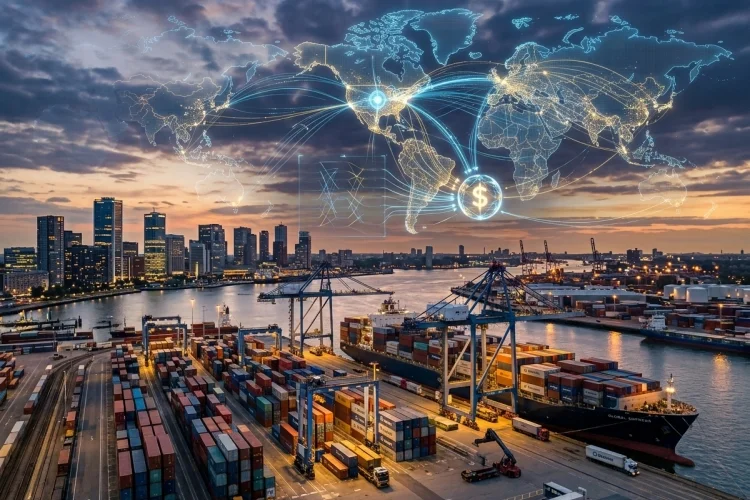
The foreign exchange market includes nearly every major currency, yet one currency appears almost everywhere: the US dollar.
Whether traders are watching EUR/USD, USD/JPY, GBP/USD, or an emerging-market pair, the dollar is usually part of the action. This dominance is not simply the result of the United States having a large economy.
The dollar sits at the centre of global trade, banking, investment, commodity pricing, government reserves, and international borrowing. These roles reinforce one another, making the currency highly liquid and convenient to use.
According to the Bank for International Settlements, the US dollar appeared on one side of 89.2% of all global foreign exchange trades in April 2025. Total daily forex turnover reached approximately $9.6 trillion, showing just how deeply the dollar is embedded in the market.
Understanding why the US dollar dominates the forex market can help beginners make more sense of currency pairs, economic news, market volatility, and the influence of the Federal Reserve.
The US Dollar Is the Most Traded Currency
Every forex transaction contains two currencies. This means the percentages assigned to individual currencies add up to 200%, rather than 100%, because each trade has two sides.
The dollar’s 89.2% share means it was involved in almost nine out of every ten forex transactions measured by the BIS in April 2025. The euro came second with a 28.9% share, followed by the Japanese yen at 16.8% and the British pound at 10.2%.
This heavy trading creates strong liquidity. In simple terms, there are usually plenty of buyers and sellers available for major dollar pairs.
High liquidity often leads to narrower bid–ask spreads and faster order execution under normal market conditions. That is one reason pairs such as EUR/USD, USD/JPY, and GBP/USD are popular with banks, companies, investment funds, and retail traders.
The Size of the US Economy Matters
The United States has one of the world’s largest and most influential economies. It is home to major corporations, large financial institutions, advanced capital markets, and enormous levels of international investment.
Businesses around the world buy American products, sell goods to US customers, invest in American companies, and raise money through US financial markets. Many of these transactions require dollars.
However, economic size alone does not fully explain dollar dominance. The Federal Reserve notes that the currency’s international role is also supported by economic stability, openness to capital flows, strong property rights, and confidence in US institutions.
Investors want more than a large economy. They also need confidence that markets will remain accessible, contracts will be enforced, and money can be moved relatively freely.
Global Trade Is Frequently Invoiced in Dollars
A company does not need to be located in the United States to use the dollar. Businesses in two completely different countries may agree to price and settle a transaction in US currency.
For example, an Indonesian company purchasing industrial materials from a supplier outside the United States might still receive an invoice in dollars. Both companies may prefer the dollar because it is widely accepted, familiar, and easier to exchange than their local currencies.
Research reviewed by the Federal Reserve found that the dollar accounted for 96% of trade invoicing in the Americas, 74% in the Asia-Pacific region, and 79% in other regions outside Europe during the studied period. The euro remains particularly important within Europe.
More recent IMF research also concludes that the dollar remains the dominant currency for global trade invoicing, although the Chinese renminbi has gained some ground in certain regions.
This widespread use creates constant demand for dollars. Importers need them to pay invoices, exporters receive them as revenue, and banks provide the currency to support those transactions.
Central Banks Hold Dollars as Foreign Exchange Reserves
Central banks keep foreign currency reserves to support exchange-rate policy, pay international obligations, provide emergency liquidity, and strengthen confidence in their financial systems.
The dollar remains the largest component of these reserves. IMF data showed that it represented 57.13% of allocated global foreign exchange reserves in the first quarter of 2026. The euro held about 20.03%, while the Chinese renminbi accounted for approximately 1.99%.
Although the dollar’s reserve share is lower than it was several decades ago, it remains far ahead of every competing currency. Reserve managers can place dollar holdings in a wide range of deposits, bonds, and other highly tradable assets.
Many countries also manage their exchange rates with reference to the dollar. When a local currency is officially pegged or informally stabilised against it, the country’s central bank may need substantial dollar reserves to defend that relationship.
US Financial Markets Are Deep and Liquid
A global reserve currency needs a large supply of assets in which governments, banks, and institutional investors can store money. The United States provides this through its Treasury market and broader financial system.
US Treasury securities are commonly used as reserve assets, collateral, investment instruments, and places to hold liquidity. They can generally be bought and sold in very large amounts, although their prices still fluctuate as interest rates and market expectations change.
The Federal Reserve reported that foreign investors held around $9 trillion, or 32%, of marketable US Treasury securities in the first quarter of 2025.
A separate US Treasury survey measured total foreign holdings of American securities at approximately $35.3 trillion as of June 30, 2025. This included equities, long-term debt, and short-term debt instruments.
Few countries can offer a comparable combination of market size, liquidity, investment variety, and access. This makes it difficult for another currency to replace the dollar quickly.
The Dollar Acts as a Vehicle Currency
A vehicle currency is used as an intermediary when two less actively traded currencies are exchanged.
Imagine that a bank needs to convert Indonesian rupiah into Mexican pesos. A direct market between those currencies may have limited liquidity. The bank might therefore convert rupiah into US dollars first, then exchange the dollars for pesos.
This process creates additional dollar transactions even though the United States is not directly involved in the original payment. The same principle applies across many emerging-market and less frequently traded currencies.
Using one common intermediary simplifies pricing and reduces the need to maintain highly liquid markets between every possible currency combination. Because the dollar already has the deepest trading network, market participants have a strong reason to continue using it.
Network Effects Reinforce Dollar Dominance
The dollar benefits from a powerful network effect: it is widely used because so many other people and institutions already use it.
Companies accept dollars because their suppliers accept dollars. Banks hold dollar liquidity because their customers need it. Central banks maintain dollar reserves because international debts and trade payments are often denominated in the currency.
This creates a self-reinforcing system. The more frequently the dollar is used, the cheaper and more convenient it becomes to trade. That convenience then attracts even more users.
Switching to another currency would require businesses, banks, investors, governments, and trading platforms to change established systems at the same time.
Unless a clear alternative offers better liquidity, stability, market access, and financial infrastructure, changing the existing system may create more costs than benefits.
The Dollar Is Central to International Borrowing
Governments and companies frequently borrow in currencies other than their domestic currency. The US dollar is particularly important in international loans, bonds, and banking activity.
A company may issue dollar-denominated debt because international investors are more willing to purchase it or because its revenues are already earned in dollars. Banks outside the United States also borrow and lend large quantities of dollar funding.
The BIS describes the dollar as a central international funding and investment currency. This means changes in dollar availability can affect credit conditions far beyond the United States.
This also explains why Federal Reserve decisions matter globally. When US interest rates rise, dollar borrowing becomes more expensive, potentially affecting companies, governments, banks, and currencies in other countries.
Commodities Are Commonly Priced in Dollars
Many internationally traded commodities, including oil, metals, and agricultural products, are quoted in US dollars. Buyers therefore need access to dollars, while exporters often receive dollar revenues.
This convention makes it easier to compare prices across countries. Instead of creating a separate global oil price in every national currency, participants can use a common dollar benchmark and convert it when necessary.
Dollar movements can also affect commodity costs. When the dollar strengthens, buyers using weaker local currencies may have to spend more of their own money to purchase the same dollar-priced product.
The World Bank notes that most commodities are priced in dollars, meaning changes in the currency can influence international commodity prices and local purchasing costs.
Could Another Currency Replace the Dollar?
Dollar dominance is strong, but it is not guaranteed forever. Concerns about US government debt, financial sanctions, policy uncertainty, and geopolitical tensions have encouraged some countries to diversify their reserves and payment systems.
The euro is the second most important international currency. Its global role increased moderately in 2025, accounting for around 20% across several measures of international currency use.
The Chinese renminbi has also expanded in trade settlement and forex activity. Its share of global forex turnover reached 8.5% in April 2025, but its share of official reserves remained below 2% in early 2026.
A major shift would probably happen gradually rather than overnight. Any serious alternative would need deep financial markets, trusted institutions, open capital flows, a large supply of investable assets, and widespread international acceptance.
Why Dollar Dominance Matters to Forex Traders
Because the dollar is involved in most forex transactions, US economic news can influence currency markets worldwide. Traders closely watch Federal Reserve meetings, inflation reports, employment data, economic growth, and Treasury yields.
A stronger dollar can push pairs such as EUR/USD and GBP/USD lower because the dollar is the quote currency. At the same time, it may push USD/JPY or USD/CAD higher because the dollar appears as the base currency.
However, the direction is never determined by US information alone. A currency pair reflects the relative strength of two economies, two interest-rate outlooks, and two sets of market expectations.
Beginners should therefore avoid assuming that positive US news will automatically strengthen the dollar. Markets often react according to whether the result was better or worse than investors had already expected.
The US dollar dominates the forex market because it combines several advantages that no other currency currently matches.
It is widely used in global trade, held by central banks, involved in international borrowing, used to price commodities, and supported by large, liquid financial markets.
These roles reinforce one another through network effects. The more businesses, banks, investors, and governments use dollars, the more practical it becomes for everyone else to do the same.
For forex traders, dollar dominance makes US economic data and Federal Reserve policy essential areas of study.
Start by following one or two major dollar pairs, learn how they react to economic announcements, and observe how expectations-not just headlines-drive exchange-rate movements.