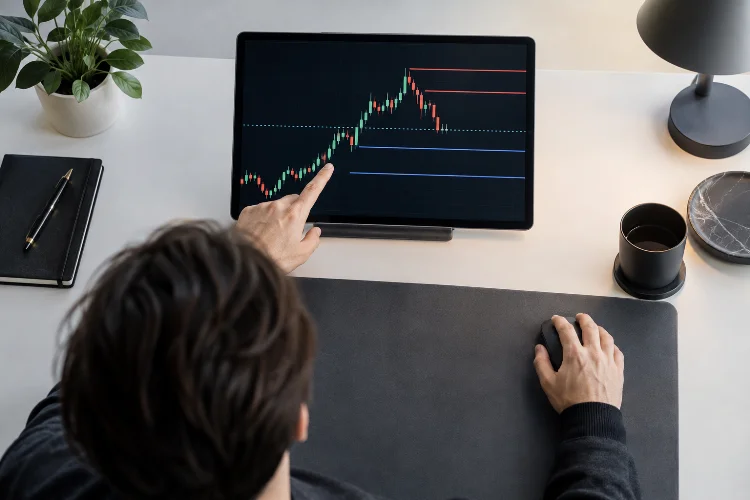
You spot a trading opportunity on EUR/USD. The price is moving quickly, and you want to enter before the move gets away from you. Should you click buy immediately, or should you tell your platform to wait until the market reaches a specific price?
That decision comes down to choosing between a market order and a pending order.
The difference may sound small, but it can completely change how a trade is entered. A market order prioritizes getting into the market now, while a pending order waits for certain price conditions before becoming active.
Understanding Market Orders vs Pending Orders Explained is especially important for new forex traders because order selection affects entry price, execution speed, slippage, and even whether a trade happens at all.
There is no universally “better” option. Sometimes immediate execution matters most. In other situations, waiting patiently for a specific level makes more sense.
Let’s break down how both order types work and when each one may be useful.
What Is a Trading Order?
A trading order is simply an instruction you send to your broker telling it what you want to do.
For example, you might instruct your broker to buy EUR/USD immediately, sell gold when it reaches a certain price, or enter a trade only if the market breaks above an important resistance level.
MetaTrader separates trading instructions into two main categories: market orders and pending orders. A market order is intended to execute a transaction at the available market price, while a pending order waits until predefined conditions are met.
It helps to separate three related concepts.
An order is your instruction. A deal is the actual transaction that occurs after execution. A position is the resulting market exposure you hold afterward.
Knowing this distinction makes the rest of the order process much easier to understand.
What Is a Market Order?
A market order tells your broker that you want to buy or sell as soon as possible at the price currently available.
Suppose EUR/USD is trading around 1.1200 and you believe the euro is about to move higher. You could submit a market buy order instead of waiting for another price level.
Your broker then attempts to execute the trade.
Market orders prioritize speed of execution rather than precise price control. MetaTrader notes that market-order execution depends on the execution method and available market conditions, while purchases generally occur around the Ask price and sales around the Bid price.
This makes market orders useful when entering immediately matters more than obtaining one exact price.
However, “market price” does not always mean the exact number displayed on your screen.
Financial markets can move between the moment you submit the order and the moment it is actually filled.
Why Market Orders Can Experience Slippage
Imagine EUR/USD is displayed at 1.1200 when you click buy.
During normal conditions, your trade might execute very close to that level. But during an important economic announcement, prices may change extremely quickly.
Your order could potentially be filled at 1.1203, 1.1205, or another available price.
The difference between the price expected and the actual execution price is commonly called slippage.
FINRA similarly warns that market orders generally execute at or near available prices, but investors may not receive the exact quote they saw, particularly in fast-moving markets.
In forex, slippage can become more noticeable around central-bank announcements, inflation reports, employment data, geopolitical news, or periods of unusually low liquidity.
This does not automatically make market orders bad. It simply means traders should understand that immediate exectuion usually comes with less control over the final entry price.
What Is a Pending Order?
A pending order takes the opposite approach.
Instead of entering immediately, you tell the broker to wait until the market reaches a predetermined price or satisfies a specific condtion.
MetaTrader defines a pending order as an instruction to buy or sell in the future when predefined conditions are met. The order can remain waiting even when the trader is not actively watching the platform.
Imagine EUR/USD is currently trading at 1.1200, but your analysis suggests that 1.1150 is a stronger entry level.
Rather than watching the screen and waiting, you could place an appropriate pending order around 1.1150.
If the required conditions are reached, the platform can trigger the order according to the broker’s execution rules.
If price never reaches that level, the trade may never happen.
That possibility is both an advantage and a disadvantage. Pending orders can encourage patience, but traders must accept that some opportunities will simply pass without an entry.
The Main Types of Pending Orders
Not every pending order does the same thing. In commonly used forex platforms such as MetaTrader, traders can choose among several types depending on whether they expect price to reverse or continue moving.
1. Buy Limit
A Buy Limit is normally placed below the current market price.
Suppose EUR/USD trades at 1.1200, but you believe price could fall toward 1.1150 before recovering.
You could place a Buy Limit near 1.1150.
The idea is essentially: “I want to buy, but only if the market comes down to my preferred area first.”
2. Sell Limit
A Sell Limit generally works in the opposite direction.
It is placed above the current market price when a trader expects price to rise to a certain level and then potentially move lower.
For example, if EUR/USD trades at 1.1200 and resistance appears around 1.1250, a trader anticipating a rejection might consider a Sell Limit around that area.
3. Buy Stop
A Buy Stop is normally placed above the current market price.
This is often associated with breakout strategies.
If EUR/USD trades at 1.1200 and an important resistance level sits near 1.1250, a trader might want to buy only if the market climbs through that area.
The trader is not looking for a cheaper entry. Instead, the trader wants confirmation that price is moving upward.
4. Sell Stop
A Sell Stop is normally placed below the market.
If support sits near 1.1150, a trader expecting further weakness after a breakdown might place a Sell Stop below that level.
MetaTrader also supports Buy Stop Limit and Sell Stop Limit orders, which combine stop-trigger conditions with limit-order behavior.
Market Orders vs Pending Orders: The Main Difference
The easiest way to remember the difference is to think about time versus price.
With a market order, your priority is usually:
“I want to trade now.”
With a pending order, your priority is closer to:
“I want to trade only if price reaches my chosen level.”
That creates an important trade-off.
Market orders offer a higher likelihood of entering quickly, but you sacrifice some control over your exact execution price.
Pending limit orders can provide more control over the acceptable price, but there is no guarantee that the market will reach your chosen level or that the order will eventually become a completed trade.
Investor.gov similarly explains that limit orders help control the price at which a transaction can occur, but they do not guarantee execution.
The best choice therefore depends on your strategy rather than on one order type being universally superior.
Stop Orders and Pending Orders Are Not Risk-Free
Setting an automatic order does not remove trading risk.
A common misconception is that once you have programmed the “correct” entry price, the trade will execute exactly as imagined.
Real markets can behave differently.
For example, a stop order can trigger during a fast market and then execute at a different price from the trigger level. FINRA warns that once certain stop orders activate and become market orders, rapid price movements can cause execution significantly away from the stop price.
Stop-limit orders address part of that problem by adding a limit price, but they introduce another issue: the market could move past the limit without filling the order.
So traders often face a choice between execution certainty and price certainty.
Neither can be completely guaranteed during extreme volatilty.
When Should You Use a Market Order?
A market order can make sense when immediate participation is the main priority.
For example, imagine your strategy produces a signal only after several conditions are confirmed. By the time confirmation occurs, you may already be comfortable entering at approximately the current price rather than waiting for a pullback.
Market orders can also be practical in highly liquid markets when spreads are relatively tight and conditions are stable.
But using them impulsively can create problems.
Clicking buy simply because price is suddenly rising can lead to emotional entries, particularly when traders are experiencing fear of missing out.
Before submitting a market order, it helps to know where your stop loss, position size, and exit plan will be.
Execution speed should not replace risk management.
When Should You Use a Pending Order?
Pending orders are particularly useful when your strategy depends on specific price levels.
Suppose your analysis identifies support at 1.1150, but EUR/USD currently trades at 1.1220.
There may be little reason to sit in front of the chart waiting.
A properly configured pending order can allow you to define your intended entry in advance.
Pending orders can also help reduce emotional decision-making because the trading plan is created before price reaches the level.
MetaTrader allows traders to configure expiration conditions for pending orders, including Good Till Canceled, current-day validity, or a specified expiration date.
This can be useful because an old trading setup may no longer make sense several hours or days later.
A plannned entry should still be reviewed when market conditions fundamentally change.
Order Type Does Not Replace Risk Management
Choosing between market and pending orders is only one part of trade execution.
You still need to consider position size, leverage, stop-loss placement, spreads, liquidity, and the amount of capital you are prepared to risk.
This is especially important in retail forex because leverage can magnify losses.
The US Commodity Futures Trading Commission warns that most registered OTC forex customers lose money and that margin trading can result in substantial losses.
It also emphasizes that OTC forex customers deal through their dealer rather than directly through a centralized exchange.
In other words, choosing the perfect entry order will not rescue a poorly managed trade.
Order selection should support a trading plan-not become the trading plan itself.
Understanding market orders and pending orders gives traders much more control over how they enter the market.
A market order is designed for situations where immediate execution matters most, although the final price can differ from the quote you initially saw.
Pending orders allow traders to wait for predefined levels, making them useful for pullbacks, breakouts, and planned entries.
Neither approach is automatically better. The right order type depends on whether your strategy prioritizes speed, price control, confirmation, or patience.
Before trading with real money, practice placing Buy Limit, Sell Limit, Buy Stop, Sell Stop, and market orders on a demo platform so you understand exactly how each behaves.
Knowing what happens before you click the button is one of the simplest ways to avoid preventable trading mistakes.