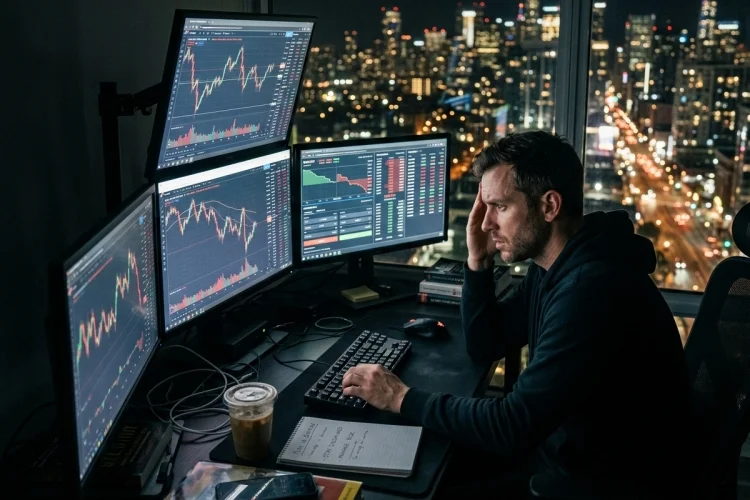
A trader can understand charts, follow economic news, and build a promising strategy-and still lose money because of poor decisions under pressure.
Knowing where to enter a trade is only part of the challenge. The harder part is remaining disciplined when real money is rising or falling on the screen. This is where trading psychology becomes important.
Trading psychology refers to the thoughts, emotions, beliefs, and behavioural habits that influence how someone trades. Fear may cause an early exit, greed may encourage excessive leverage, and overconfidence can make a trader ignore risk after several wins.
These behaviours matter because financial markets are uncertain. No setup can guarantee an outcome, and every trader eventually experiences losses.
The ability to follow a plan during those uncomfortable moments can be more valuable than finding another technical indicator. In leveraged markets such as forex, emotional mistakes can become especially expensive.
The CFTC reports that roughly two out of three customers at registered over-the-counter forex dealers lose money after costs are considered. Psychology is not the only reason, but it can strongly influence how traders respond to risk.
What Is Trading Psychology?
Trading psychology is the study of how mental and emotional factors affect trading decisions. It covers everything from a trader’s attitude toward uncertainty to their reaction after a large profit or painful loss.
A trading plan may tell someone to risk 1% of their account and close a position when the setup becomes invalid. Psychology determines whether they actually follow those rules.
For example, a trader may plan to exit EUR/USD after it falls below support. When the level breaks, however, the trader refuses to close because accepting the loss feels uncomfortable. They move the stop-loss farther away and hope the market will recover.
The original market analysis is no longer controlling the decision. Emotion has taken over.
Good trading psychology does not mean eliminating emotions. Fear and excitement are natural reactions when money is at risk. The goal is to recognise them without allowing them to override a carefully prepared process.
Why Emotions Affect Trading Decisions
Trading combines money, uncertainty, competition, and fast feedback. This creates an environment where emotions can easily become stronger than logical thinking.
A normal business decision may take several days. A forex position can move into profit or loss within seconds, encouraging traders to react before considering the consequences.
The brain also does not evaluate gains and losses equally. Prospect theory, developed by Daniel Kahneman and Amos Tversky, found that people commonly treat gains and losses differently and may become more willing to take risks when trying to avoid a sure loss.
In trading, this may appear when someone quickly closes a profitable position to secure a small gain but keeps a losing position open because they do not want to admit the idea failed.
Emotional decisions are not always dramatic. They may appear as slightly increasing position size, entering a few minutes too early, or skipping one important rule. Repeated over many trades, these small choices can significantly affect performance.
Fear, FOMO, and Hesitation
Fear can protect traders from reckless decisions, but excessive fear creates different problems.
A trader who recently experienced several losses may hesitate when the next valid setup appears. They watch the price reach their planned entry but cannot click the button. When the market eventually moves in the expected direction, frustration increases.
Fear of missing out, commonly called FOMO, creates the opposite reaction. Instead of hesitating, the trader enters because the price is already moving quickly and they worry the opportunity will disappear.
Investor.gov warns against making financial decisions simply because other people are buying or because an opportunity appears fashionable or urgent. Following trends and influencers through FOMO can expose people to substantial volatility and poor decisions.
Imagine that gold or a currency pair rises sharply after an economic announcement. A trader who missed the original move buys near the top without checking the entry, stop-loss, or reward-to-risk ratio.
The market then pulls back normally, but the rushed entry creates an immediate loss. The problem was not necessarily the market direction. It was the emotional decision to chase it.
Greed and Overconfidence
Greed often appears when a trader wants to earn more than the original plan allows. A reasonable position suddenly seems too small, so the trader increases leverage or opens several similar trades.
Overconfidence commonly develops after a winning streak. The trader begins believing recent profits prove that they can accurately predict the market.
They may stop using stop-losses, ignore economic risks, or take setups that would previously have been rejected. One successful trade then becomes evidence that the careless behaviour was correct.
Research by Brad Barber and Terrance Odean examined more than 66,000 brokerage households.
The most active traders earned an annual return of 11.4% during the study period, compared with a 17.9% market return. The researchers linked high trading activity and poor results partly to overconfidence and trading costs.
The study examined stocks rather than forex, but the behavioural lesson is relevant across markets: more activity does not automatically create better performance.
A confident trader follows a tested process while accepting uncertainty. An overconfident trader assumes that skill removes uncertainty.
Loss Aversion and the Disposition Effect
Loss aversion describes the tendency to experience losses more strongly than equivalent gains. Losing US$100 may feel more painful than earning US$100 feels satisfying.
This can produce the disposition effect, where traders close winning positions too early but hold losing positions for too long.
Terrance Odean studied 10,000 brokerage accounts and found that investors showed a strong preference for realising gains rather than losses.
The investments they sold continued to outperform many of the losing positions they kept, meaning the behaviour was not justified by later performance.
In forex trading, a person might close a profitable trade after earning 20 pips because they fear the gain will disappear. However, they may allow another position to lose 80 pips while waiting for it to recover.
The trader could maintain a respectable win rate and still lose money because the average loss is much larger than the average gain.
A stop-loss helps address this problem by defining the point where the trade must close. However, the tool only works when the trader respects it instead of repeatedly moving it.
Revenge Trading and Emotional Overtrading
Revenge trading happens when someone tries to recover a loss as quickly as possible. The next trade is driven by frustration rather than a valid setup.
Suppose a trader loses US$100 after following their plan. Instead of accepting the result, they double the next position because they want to return to breakeven immediately.
If that position also loses, the emotional pressure becomes stronger. The trader may increase the size again, producing a cycle of larger risks and increasingly careless decisions.
Overtrading can also result from boredom. When no clear opportunity exists, some traders feel that they should be doing something simply because the platform is open.
Mobile apps and constant notifications can make this behaviour easier. Investor.gov notes that entertaining, game-like interfaces and frequent notifications may encourage excessive trading, while social media can expose users to incomplete or misleading financial information.
A professional mindset accepts that waiting is part of trading. Not opening a position is a valid decision when market conditions do not match the strategy.
Confirmation Bias and Recency Bias
Confirmation bias causes people to search for information that supports what they already believe while ignoring evidence that challenges them.
A trader who expects EUR/USD to rise may focus on bullish candlesticks and positive eurozone data. At the same time, they dismiss a broken support level or unexpectedly strong US economic figures.
This creates the illusion that the trade remains valid because the trader has selected only favourable information.
Recency bias occurs when recent events receive too much importance. After three winning trades, someone may believe the strategy cannot fail. After three losses, they may abandon a sound method completely.
Neither conclusion is reliable because a few outcomes reveal very little about long-term performance. Even a strategy with a genuine statistical advantage can experience losing streaks.
A trading journal can reduce these biases by creating a written record. Instead of depending on memory, traders can review the actual entry conditions, rule compliance, costs, and results across a meaningful sample.
Why Discipline Matters More Than Motivation
Motivation is temporary. A trader may feel extremely focused after reading a book or watching an educational video, but that energy can disappear during a stressful market session.
Discipline is the ability to follow predetermined rules even when following them feels uncomfortable.
This includes accepting a planned loss, avoiding an impulsive entry, keeping position size within limits, and stopping after reaching a maximum daily loss.
CME Group recommends defining important risk parameters in advance, including intended leverage, maximum loss per trade, maximum daily loss, and total account exposure. These rules reduce the number of decisions that must be made while emotions are active.
Discipline does not require perfect behaviour. Traders will occasionally make mistakes. The important step is identifying the mistake quickly and returning to the process instead of allowing one broken rule to become an entire day of uncontrolled trading.
How to Build Better Trading Psychology
Better psychology begins with a written trading plan. The plan should define the setup, entry conditions, stop-loss, profit target, risk limit, and situations where trading is not allowed.
Position size should be small enough that a normal loss does not create panic. When the financial risk feels overwhelming, the position is probably too large.
A pre-trade checklist can also slow impulsive decisions. Before entering, confirm that the setup matches the strategy, the stop is logical, the reward justifies the risk, and no major announcement is about to occur.
After each trade, record the reason for entering and the emotions experienced. Note whether fear caused an early exit, greed increased the target, or frustration encouraged another position.
Regular breaks are equally important. Fatigue reduces concentration and makes emotional reactions harder to control. Stopping after several trades or a predetermined daily loss can protect both capital and decision quality.
Finally, judge yourself by the quality of the process rather than the result of one trade. A planned trade can lose despite being well executed. An impulsive trade can make money through luck.
The first is a good decision with an unfavourable outcome. The second is a dangerous decision that happened to receive a favourable outcome.
Trading psychology describes how emotions, beliefs, and cognitive biases influence financial decisions.
Fear can create hesitation, greed may encourage excessive leverage, overconfidence can cause overtrading, and loss aversion may keep unsuccessful positions open for too long.
These reactions cannot be completely removed, but they can be managed through structure. A written trading plan, conservative position sizing, predetermined exits, daily loss limits, and a detailed journal make emotional behaviour easier to identify and control.
Begin by reviewing your last ten trades. Look beyond profit and loss and ask whether every position followed your rules. Choose one repeated psychological mistake, create a specific rule to address it, and practise that rule consistently before increasing your trading risk.